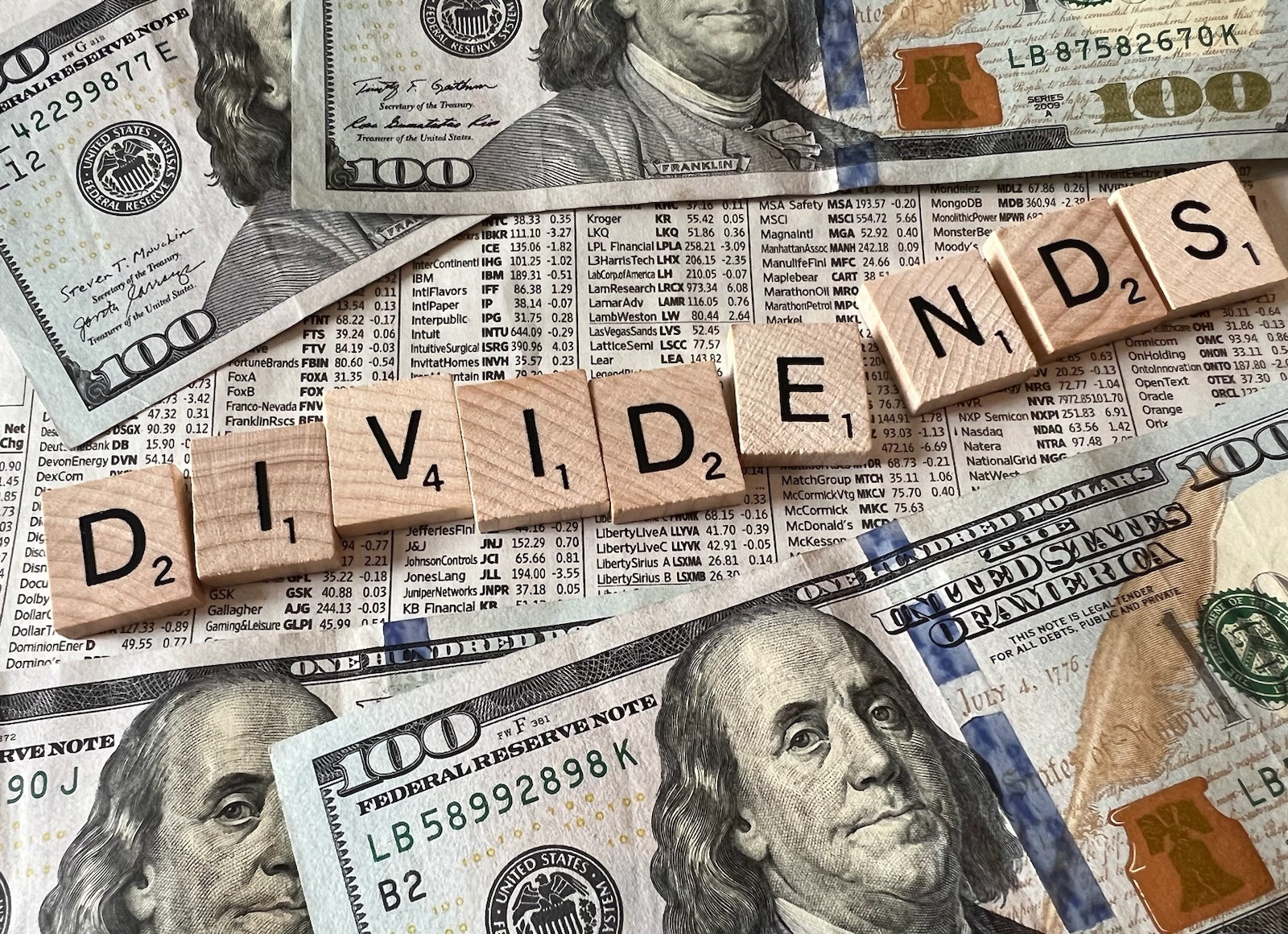
Many long-term investors just love receiving dividends. Many retirees even supplement their retirement income with those juicy dividend payments they have received for many years. This used to be called “mailbox money” in the past, and about one-third of total returns over time have been attributed to dividends. Unfortunately, and certainly for younger investors, that “dividend haven” strategy may now be showing some significant cracks that has be given strong consideration.
The unfortunate reality is that dividend yields are now lower than they used to be. Dividend-paying stocks have also not performed as well in recent years as many of the great growth stocks like NVIDIA, Apple, Amazon, Meta, Tesla, Microsoft and so on. And to make matters even more complicated in dividend land, the rate of dividend hikes and the number of companies raising their dividends is not what it used to be either.
S&P Dow Jones Indices has released fresh data confirming that dividend hikes are on the decline, the rate of hikes is lower, and overall dividend yields are not what they used to be. The news is certainly not all gloom and doom. But there has certainly been a passing of the baton when it comes to investing for dividends versus investing for growth.
S&P tracked the net dividend changes in the top 1,500 stocks from the S&P 500 and from its Mid-Cap 400 and Small-Cap 600 stocks. This net change is simply measured by overall dividend increases (plus initiations of dividends) minus the number of dividend decreases. One problem complicating matters is that it’s not just the mega-cap leaders skewing these numbers.
Tactical Bulls has pulled some outside data to see what changes new investors need to keep in mind. From 1940 to 2024, dividends have accounted for roughly one-third (34%) of the S&P 500’s total return over time. Here are some stats taken from outside sources:
- The top 10 holdings (all mega-caps) in the S&P 500 now account for about 38.8% of the entire index.
- None of the top 10 components of the S&P 500 even pay a 1% dividend yield based on their current share prices.
- Of the 414 dividend-paying stocks from the S&P 500, the median yield is now just 1.94%.
- The “Dividend Aristocrats” (25 consecutive years of dividend hikes) currently yield about 2.1%.
- Dividend growers are not keeping up with growth stocks and the broader market indexes in any recent period.
Here is how much less the performance of top dividend payers has been versus the broad market. The ProShares S&P 500 Dividend Aristocrats ETF (NYSEArca: NOBL) was last seen up just 2.8% YTD in 2025, versus gains of 13.5% for the S&P 500 Index. And the gains have been sub-par over the last three-year period as well — just 26% for the NOBL ETF versus 84% for the S&P 500.
Getting back to S&P’s data on dividends from their full Q3/2025 report shows specifics on the cracks. While there were 421 dividend increases (or initiations) in Q3/2025 from all dividend paying companies, that was down 12,3% from the 480 increases (and initiations) during Q3/2024. The total dividend increases of $14.0 billion in Q3/2025 was versus $14.1 billion in Q3/2024.
One issue to consider about higher overall stock prices is that dividend hikes have to rise faster than the share price growth for a dividend yield to rise (at current stock prices) over time. S&P showed that dividend yields overall were lower in Q3/2025 than in Q3/2024 simply because stock prices gained faster than the growth of their dividends.
Before setting into panic mode that dividend hikes are coming a screeching halt, the conclusion from S&P was that dividends for Q4/2025 are likely to set to a new quarterly record. And for the full year of 2025, S&P 500 dividend payments are expected to be at record levels with nearly a 6% increase over the dividends paid in 2024.
For the 12-months ending September 2025 U.S. common dividend increases were $57.5 billion, down 23.1% from the 12-month September 2024 period’s $74.7 billion; decreases were down 36.4% to $12.4 billion compared to $19.5 billion for the prior 12-month period.
Here are some stats that will also show at least some concerns brought up in the S&P report on indicated dividend net changes for U.S. domestic common stocks:
- they increased $10.6 billion in Q3/2025 — higher than the $7.4 billion net gain in Q2/2025 and higher than the $9.5 billion net gain in Q3/2024.
- the dividend increases were $14.0 billion in Q3/2025 — versus $9.8 billion in Q2/2025 and versus $14.1 billion in Q3/2024.
- the dividend decreases were $3.4 billion in Q3/2025 — versus $2.3 billion in Q2/2025 and $4.6 billion in Q3/2024.
For the 12-months ending September 2025, the net dividend rate increased $45.1 billion compared to the net $55.3 billion for the prior 12-months ending September 2024. And here are some historical data to look back at dividend trends in prior years:
- For 2024 it was up $53.4 billion,
- for 2023 it was up $36.5 billion,
- for 2022 it was up $68.2 billion,
- for 2021 it was up $69.8 billion,
- and the 2020 net change dividend change during Covid was negative as 43 of S&P 500 stocks at the time suspended their dividends (for a total of -$40.8 billion).
Several additional concerns and trends were brought up by S&P regarding dividend growth specific to 2025:
- uncertainty over evolving tariff polices (and their impact on sales);
- impact of tariffs on sales, costs and the general economy;
- dividends increases were smaller for companies raising dividends annually;
- many companies not on regular dividend hike schedules have put off their actions (for now);
- companies may still increase their dividends, but want to see more legislative and executive assurances before making long-term dividend commitments.
There are also some broader stats on dividend-paying stocks from the S&P 500, with the Mid-Cap and Small-Cap indexes also measured in Q3/2025 versus Q3/2024:
- 407 stocks (80.9%) in the S&P 500 paid a dividend, up from 404 in Q3/2024.
- 65.3% of S&P Mid-Cap 400 index paid a dividend, down from 66.6% in Q3/2024.
- 57.6% of S&P SmallCap 600 index paid a dividend, down from 58.0% in Q3/2024.
Some investors may take this reporting that dividend investing is a lost art that is becoming irrelevant. Does it even matter any longer that the great Warren Buffett has made a significant portion of his overall massive gains for Berkshire Hathaway (NYSE: BRK-B) over time… Investing in dividends may not be dead, but there are some significant issues that younger investors and older investors alike now have to consider. And some of those considerations and statistics may look alarming for classic investing styles.
Categories: Investing