
Palo Alto Networks, Inc. (NASDAQ: PANW) almost turned its shares into “a broken stock” after the company reached an agreement to acquire CyberArk Software Ltd. (NASDAQ: CYBR). Almost is almost, at least for now. The initial reports of a $20+ billion acquisition turned into a $25 billion deal in cash and stock, putting serious pressure on Palo Alto’s stock price.
Its stock went from $204.50 to $194 on the initial merger report. Then the stock fell to $173 after the deal confirmation. And then its shares then went down to $167 before staging a trading recovery. What does it imply for longer-term for investors?
With strong guidance and strong commentary, Tactical Bulls wants to see if this was really marking a trading bottom and clearing out the negative post-deal sentiment. Please keep in mind that the verdict on whether or not this represents a longer-term bottom will depend on the stock market as a whole and ongoing investor sentiment based on many factors outside of what short-term traders look for.
Palo Alto’s costly acquisition took its market capitalization from over $130 billion to see a (recently) unprecedented drop down almost 20% from start to the recent lows. It was as if the CyberArk total deal price was being taken out of Palo Alto’s shares.
Some investors and analysts had been concerned that maybe this merger was signaling a peak of Palo Alto’s ability to grow on its own. Then came words of “Not so fast!” from Palo Alto on Monday with its earnings and guidance update. The news had Palo Alto’s stock back up another 6% to $187.50 on Tuesday morning.
Mid-day trading was showing perhaps a little less enthusiasm. CyberArk’s stock was up 2.6% at $433.00 and Palo Alto’s stock was up 3.1% at $181.70. And Palo Alto’s 21.7 million shares at 1:00 pm Eastern Time was already nearing 3-times normal trading volume.
The good news for Palo Alto investors is that the stock jumped and Wall Street by and large raised its expectations for 2026 guidance. Management has now signaled net customer retention at 120%, implying that it is adding one net new customer for every 5 customers it already has. And CEO Nikesh Arora said that the company’s (security) software market share was now running at “nearly 50%.”
ALSO READ: REVISITING A BROKEN TECH IPO
Wall Street was able to relax. Analysts have chimed in with mostly positive commentary and with strong to stronger price targets after many firms hiked their expectations. The post-guidance financial media headlines were also supportive:
- Barron’s — Palo Alto Stock Jumps. Why It Can Dominate Cybersecurity
- Bloomberg — Palo Alto Gains on Strong Results After Cyberark Deal
- Dow Jones (Market Talk) — Palo Alto Networks’ Outlook Didn’t Undershoot Targets as Feared
- TheStreet.com — New Potential Palo Alto Networks Price Target After Shares Burst
- Reuters — Palo Alto’s Forecasts Signal AI Boost for Cybersecurity Tools, Shares Rise
- MarketBeat — Palo Alto Networks Uptrend Confirmed! New Highs Set by Year’s End
- CNBC — Palo Alto Networks CEO: Earnings Show ‘Fundamental Market Shift’
- Investopedia — Big Demand for Cyber Protection Powers Palo Alto Networks Results, Outlook
- Investors Business Daily — Cybersecurity Firm Palo Alto Pops on Strong Fiscal 2026 Guidance Amid CyberArk Deal
- Investing.com — Palo Alto Networks Gains After Strong Earnings and Bank of America Upgrade
WALL STREET ANALYSTS SPEAK…
Now it’s time to see what Wall Street analysts are saying on the heels of its raised guidance. Tactical Bulls has seen mostly positive commentary from the bulk of analyst reports in the wake of Palo Alto’s earnings and guidance. Some firms did not adjust targets, and there was even one firm remaining cautious.
BofA Securities has decided to raise Palo Alto’s rating back to Buy from Neutral on the news, but the firm’s price objective was maintained at $215 in the call. The firm’s Tal Liani noted strong FY-2026 guidance along with underlying solid fundamentals. On top of individual categories and revenues coming in above consensus estimates, management also noted strength in platform deals and software products. The firm did note the reason its price objective is not changed because valuation and possible peaking margins remain the firm’s key concerns with the company guiding to 38.5% free cash flow margin in FY-2026. BofA’s investment rationale said:
Our Buy is based on strong financials across the majority of Palo Alto’s business. Platformization deals continue to see solid growth and strong NRR. The company also is benefitting from software modules and software products. FCF is also expected to step up over the next few years. We favor PANW’s technological and product leadership which should help to solidify Palo Alto as a cybersecurity leader longer-term.
Here are some other firm’s reiterating their rating and raising price targets:
- Barclays (Overweight) target raised to $215 from $210
- Bernstein (Outperform) target raised to $207 from $204
- CFRA (Buy) target raised to $218 from $210
- Goldman Sachs (Buy) target raised to $236 from $231
- Morgan Stanley (Overweight) target to $210 from $205
- Rosenblatt (Buy) target raised to $225 from $215
- Scotiabank (Sector Outperform) target raised to $228 from $225
- Truist Securities (Buy) target raised to $220 from $205
Several firms reiterated their ratings and kept their prior price targets in place:
- DA Davidson (Buy) target maintained at $215
- JMP Securities (Outperform) target maintained at $212
- Needham & Co. (Buy) target maintained at $230
- RBC Capital Markets (Outperform) target maintained at $232
- Stephens & Co. (Equal-Weight) target maintained at $205
- Wedbush Securities (Outperform) target maintained at $225
And there was still a negative call, of sorts:
- Guggenheim is a standout call, maintaining its “Sell” rating even though it still hiked its price target to $135 from $130.
ALSO READ: TACTICAL CALLS FOR A.I. LEADERS CREEP HIGHER
Wall Street may be more likely to view this as a potential trading bottom of sorts. That doesn’t mean the stock can’t drift lower by any means. And over the long-term, trying to determine whether or not long-term bottoms have been seen require investor sentiment and money flows to support the stock at higher prices –and that requires looking at it over time.
A chart from StockCharts.com has also been provided.
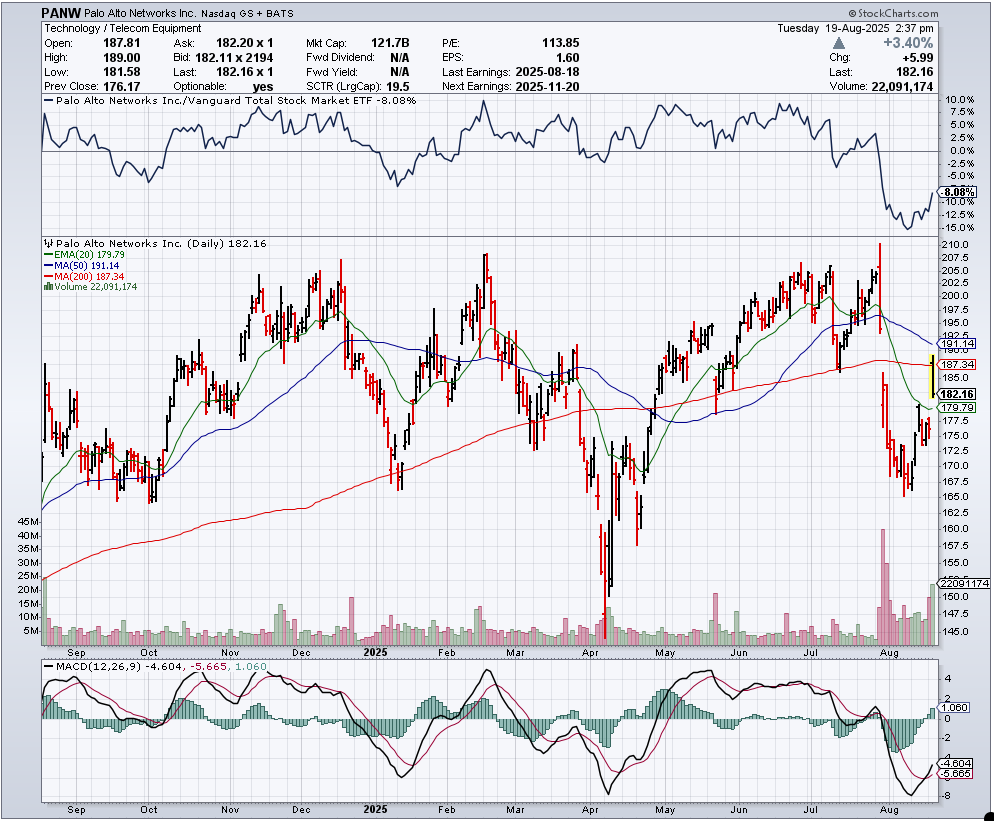
Chart provided courtesy of StockCharts.com
DISCLAIMERS REGARDING RATINGS/TARGETS
The analyst ratings and price targets mentioned above have been credited to each firm by name. Investors should keep in mind that analysts sometimes get their thesis and outlook wrong. Another risk is that market/company fundamentals can change from positive to negative in an instant.
Tactical Bulls does not have any formal ratings and does not maintain any price targets of its own regarding Palo Alto Networks and CyberArk. Interpretations of how positive or negative the analyst calls are can also wildly vary from investor to investor.
No analyst ratings and their price targets, even those with the strongest conviction or strongest pessimism, ever come with any guarantees of profits. Analyst reports also never have money-back guarantees in the event that investors lose money.
Categories: Investing