Tactical investors are willing to go just about anywhere where they feel their capital will either be safe or will outperform. Technicians just want to look at the charts. So, what happens when there is a tactical investment that also coincides with a technical set-up for the pure chartists? It’s time to reflect on James Hardie Industries plc (NYSE: JHX) as both tactical and technical!
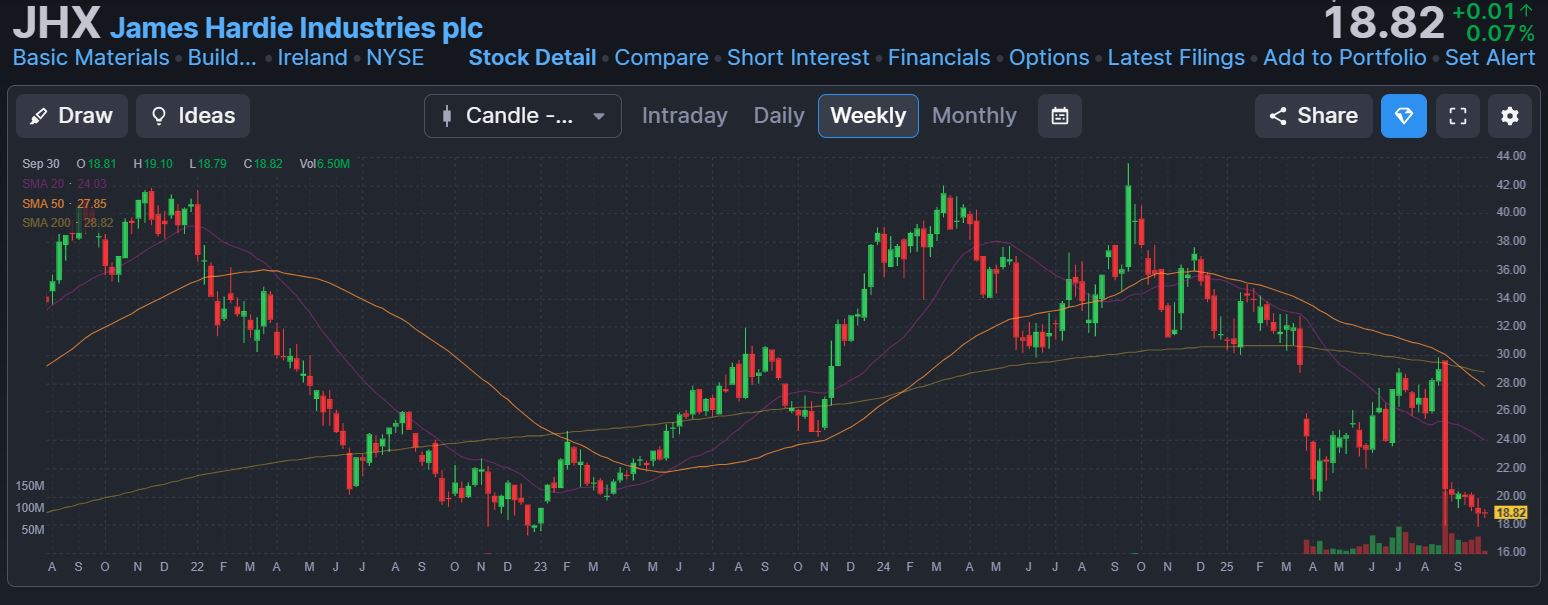
James Hardie Industries has experienced a major pullback in 2025, with shares down 38% YTD and down 50% from a year ago. It has a potentially massive technical set-up for the pure chartists who are looking for charts seeking long-term bottoms.
So why is James Hardie in the right place at the right time now? There are multiple reasons. Just don’t ever forget that there are no guarantees on Wall Street.
Please keep in mind that any and all research reports have been credited to the firms issuing those reports by name. Tactical Bulls maintains no price targets or formal ratings of its own for the stocks mentioned in this reporting.
James Hardie Industries is the de-facto leader in manufacturing fiber cement siding and cement bonded boards used for houses and other structures. It even has the generic term of “Let’s use Hardie board siding” for homes. And its products blow away vinyl siding and shingling of yesteryear. And it looks better than wood siding used by cheaper builders.
A fresh analyst report is out from Wolfe Research with a brand new Outperform rating and a $25 price target. That’s an implied upside of nearly 33% from the prior $18.81 closing price. And while the stock market is effectively bumping against all-time highs, James Hardies’ stock has a 52-week range of $17.85 to $40.54.
According to Wolfe Research, the recent stock pullback (it has been more severe than that actually) offers investors an attractive entry point that has largely been de-risked (see chart below).
Wolfe Research’s fundamental view is that James Hardie is a structural growth story. The report cited that its fiber cement segment is continuing to take market share from the cheaper and less attractive vinyl siding used by builders.
Another driver is that the Hardie acquisition of Azek should also generate accelerated growth and margin expansion for the company. Just don’t expect that growth to return immediately.
As for recent performance, Hardie’s stock shares plunged by more than 30% in September after disclosing significant issues with its North America business. It is based in Australia, but the mainstay markets are in North America with operations and sales in Europe and Asia as well.
The company is still in the integration process with Azek for decks, railing and accessories. The company sees “solid sell-through growth” and a “resilient demand profile of the category” along with “TimberTech’s strong value proposition.” Still, it is not immune to soft housing trends and housing affordability issues. Its latest guidance from August said:
“Presently, demand in both repair & remodel and new construction in North America is challenging. Uncertainty is a common thread throughout conversations with customer and contractor partners. Homeowners are deferring large-ticket remodeling projects like re-siding, and affordability remains the key impediment to improvement in single-family new construction, where more recently, homebuilders are moderating their demand expectations and slowing starts to align their home inventory with a decelerating pace of traffic and sales.”
The translation above is that slower sales are expected to remain during the remainder of 2025. Hardie also pushed some growth and recovery out into Fiscal Year 2027 rather than its prior forecast of recovery in the second-half of 2026. And here are four segments’ guidance for 2026:
- Net Sales for Siding & Trim: $2.675 to $2.850 billion
- Net Sales for Deck, Rail & Accessories: $775 to $800 million
- Total Adjusted EBITDA: $1.05 to $1.15 billion
- Free Cash Flow: At least $200 million
With shares at $18.85 on last look, the building materials stock has a market cap of about $11 billion.
Jefferies had initiated coverage in early August, before the disappointing earnings report, with a Buy rating and an even more aggressive $34 price target. Other analysts in the U.S. and internationally have more recently lowered their price targets and some even issued formal downgrades to reflect the lower guidance.
One additional issue worth consideration is that the U.S. Federal Reserve had not begun its interest rate-cutting campaign when its guidance was issued. It may be two or even three more short-term rate cuts before serious help is on the way via lower mortgage rates that are tied closer to 10-year Treasury yields rather than Fed Funds and 1-year Treasury Bills. Two to three more rate cuts are being priced into the CME FedWatch Tool — and it is overwhelmingly expected that President Trump will replace Jerome Powell with a more “rate friendly” Chairman in mid-2026 when Powell’s term ends.
One last warning and disclaimer… Tactical Bulls always reminds investors that no single analyst report should ever be the sole reason to buy or sell a stock. Analysts can get their thesis wrong. And sometimes the underlying fundamentals can change in an instant.
Below is a weekly stock chart going back to 2021 that is courtesy of FinViz.com.
Categories: Investing