It seemed like every initial public offering in 2025 could do now wrong. NIQ Global Intelligence PLC (NYSE: NIQ) sold 50 million shares in late-August at $21 per share. Its pre-IPO underwriter price range indications had been $20 to $24 per share.
The problem with NIQ’s stock is that it has performed poorly when the broader market has been performing well. It only opened at $20.25, and then went down to close at $19.01 on 21.9 million shares in its first day. And it closed at $17.94 last Friday ahead of its quiet period expiration.
If someone bought at the IPO subscription price of $21, they were down almost 15% as of Friday’s close. That is without considering Monday’s quiet period expiration seeing another 2.6% drop to $17.47. The NASDAQ-100 was up 2.1% and the S&P 500 was up 1.5% since NIQ’s IPO debut.
Now Wall Street’s underwriting syndicate has come out with multiple Buy and Hold recommendations as the quiet period has expired. The underwriting group was rather large with JPMorgan, BofA, UBS, Barclays and RBC listed as the 5 joint lead book-running managers – and another 16 firms listed as additional underwriters.
Tactical Bulls wants to look further under the hood here to see if there is more to this story than the initial post-IPO price drops would indicate.
One more interesting aspect is that many of the shares sold to the public may be tight hands, with just 60 million shares in total having traded hands leading up to the quiet period expiration (including the 21.9 million shares on its trading debut).
THE COMPANY
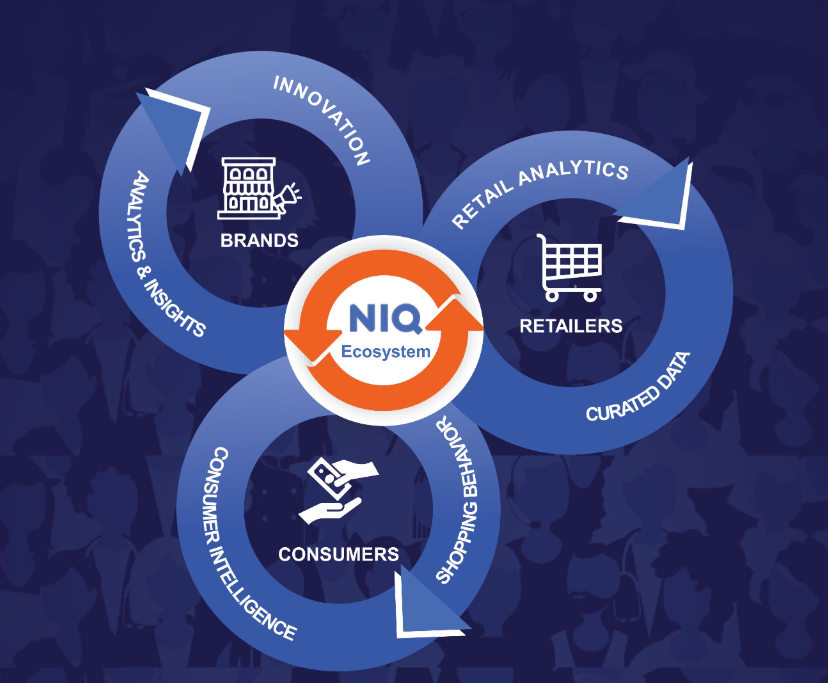
NIQ has the hallmarks of a winner on the surface as a leader in consumer intelligence, offering consumer buying behavior analytics and “new pathways to growth.” NIQ merged with GfK in 2023 and the combined operations now spans over 90 countries, covering approximately 85% of the global population. In short, it tracks over $7.2 trillion in global consumer spending habits.
With a market cap of $5.3 billion, the company has around 23,000 active clients and it counts around half of the Fortune 500 in that client roster. Its S-1 IPO filing showed that revenue in 2024 was about $4 billion, with 6.2% organic revenue growth (constant currency). Roughly 80% of that revenue is recurring in a subscription model and it claims to have 105% net dollar retention as of Q1-2025.
There are also some big concerns that some investors may have with it being a controlled company. This has also been outlined below.
Wall Street looks mixed on the firm (see below). Some of the commentary talks about mid-single-digit growth, and other commentary talks about a heavy debt load. Still, many analysts noted that the downside should be priced in and some of the price targets from the “Neutral/Hold” ratings were very close to some of the “Buy/Outperform” ratings and targets.
PE CONTROL & SHARE SALE CONCERNS
NIQ has a private equity syndicate that owned all outstanding shares ahead of the IPO. Advent was a seller of 7.5 million shares, owning 154.8 million shares after the IPO (still a 52.5% stake). Other firms have following shares and stakes:
KKR 29,974,219shares for a 10.2% stake
NIM 34,991,997 shares for a 11.9% stake
VNU 17,696,448 shares for a 5.7% stake
One ongoing issue that investors may worry about in the case of NIQ is that private equity owners are generally expected to be sellers of post-IPO stocks they have sold to the public. Those sales can sometimes take several years to clear out.
The prospectus described the implications of being a controlled company by noting that its principal shareholders will own approximately 77.0% of the ordinary shares (or 74.5% if the overallotment option was exercised). This means that all lockup expiration dates (when PE firms can sell more shares) will be watched rather closely.
USE OF FUNDS, AND LOTS OF DEBT!
As for the “use of proceeds,” plans to repay its revolving credit facility and to pay down a portion of its US term loan facility. Any remaining proceeds were earmarked for working capital and for general corporate purposes. The company included the note that it would not receive any proceeds from the share sale by the selling shareholder.
The company also had a heavy debt load from being involved in leveraged M&A prior to its reorganization — some $4.215 billion in long-term debt, with a total liabilities of $6.137 billion.
WALL STREET COVERAGE
B of A (Buy) $23 price target, noting that NIQ will penetrate a large addressable market ($57 billion!) after an extensive turnaround and acquisition of GfK as a one-stop suite of solutions for consumer packaged goods companies.
Barclays (Overweight) $24 price target, calling it limited downside in the stock based on a turnaround, with its free cash flow conversion deserving a look.
BMO Capital (Outperform) $24 price target, noting an attractive entry after post-IPO weakness with mid-single-digit revenue growth expected long-term from subscription price increases and moving into smaller markets and new verticals.
JPMorgan (Overweight) $21 price target… noting the leader in global consumer product measurement with a heavy debt load and low free cash flow conversion being priced in versus current valuations.
Needham (Buy) $24 price target… noting that its organic growth has reached mid-single digit pace in revenues, higher margins and improving cash flow conversion.
RBC (Outperform) $24 price target… seeing it as a global leader in measuring, analyzing, and predicting consumer behavior. Also noted a revamped and seasoned management team with a solid execution runway to drive mid-single-digit revenue growth ahead.
Stifel (Buy) $24 price target… noting the consumer intelligence provider will see mid-single-digit organic revenue growth, margin expansion and de-leveraging over the next few years.
UBS (Buy) $24 price target, noting its shares aren’t pricing in revenue growth and efficiencies, with high barriers to entry for its mission critical data.
Wells Fargo (Overweight) $21 price target… calling it well positioned with rising demand for data and analytics, an attractive business model, over 80% recurring revenue, and hard to replicate data assets on consumer shopping activity.
William Blair (Outperform) No price target listed, noting a best-of-breed data and technology platform.
Additional new ratings were seen as follows:
- Citigroup (Neutral) $21 price target
- Deutsche Bank (Hold) $21 price target
- Baird (Outperform) $24 price target
IN THE END…
There you have it. NIQ’s IPO has been a dud, but even the “Neutral/Hold” ratings are coming with price targets closer to the IPO price of $21 rather than the sub-$18 share price after their ratings reactions.
All analyst ratings and price targets listed above were directly from the firms named. Tactical Bulls does not have any formal ratings nor any price target of its own regarding NIQ.
Categories: Investing